
What It Does
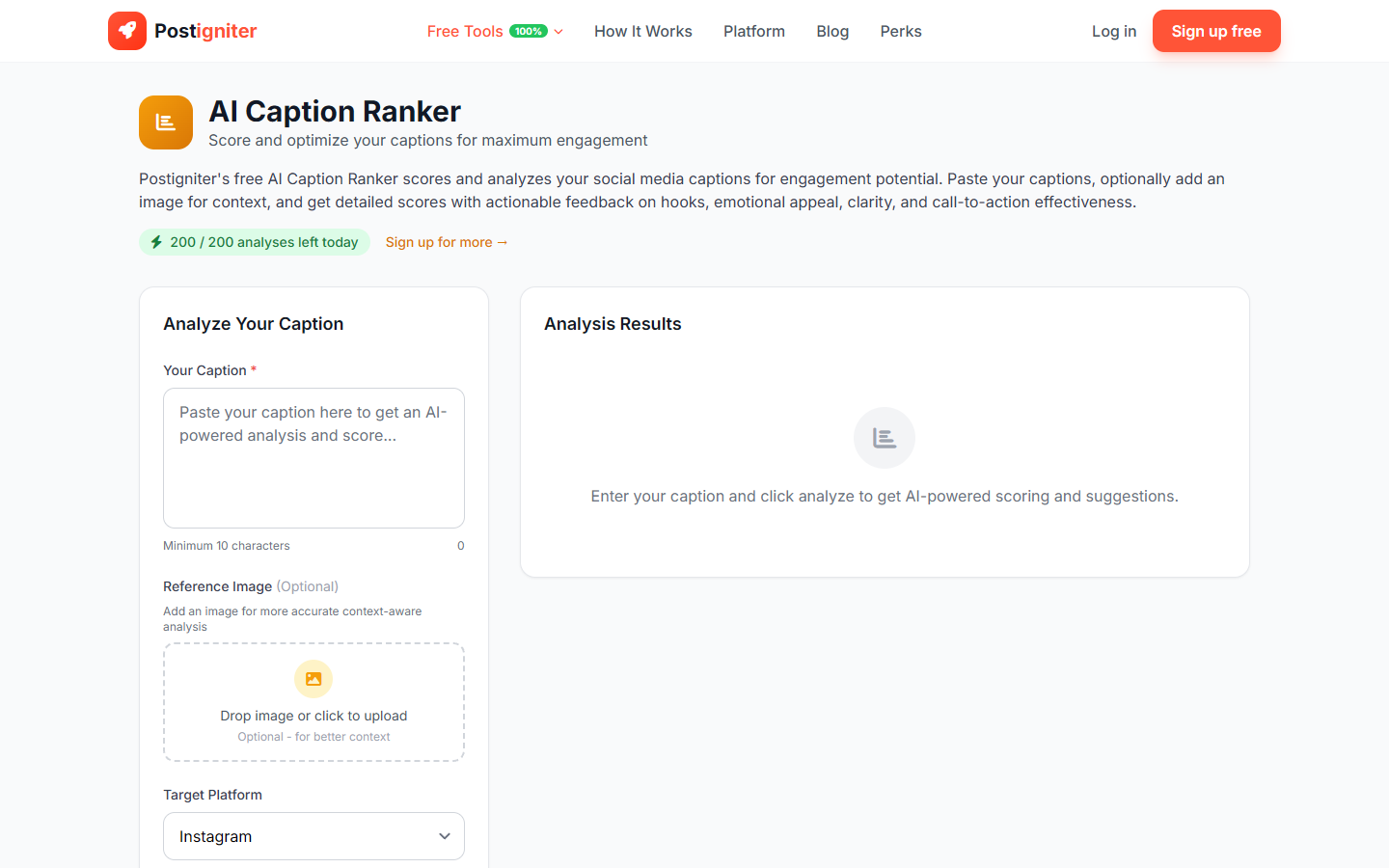
The Caption Ranker analyzes a social media caption you've written and gives it a detailed quality score with specific improvement suggestions. Instead of guessing whether your caption will perform well, you get an objective breakdown of its strengths and weaknesses — and how to fix the weak spots before posting.
How to Use It
- Enter your caption — Paste or type the caption you want to analyze. Minimum 10 characters; maximum 2,200 characters (Instagram's limit).
- Choose your platform — Select the platform you're posting to: Instagram, Facebook, Twitter/X, LinkedIn, or TikTok. The analysis criteria adjust for each platform's norms and character constraints.
- Upload an image (optional) — Upload a JPEG, PNG, GIF, or WebP image of your post visual. When provided, the AI considers how well the caption complements the image, not just the text in isolation.
- Click Analyze Caption.
Understanding the Results
The analysis returns a score and feedback across several dimensions:
- Overall score — A quality rating with a tier label (Needs Work / Good / Great / Excellent)
- Hook strength — How well the opening line captures attention
- Readability — Sentence structure, length, and flow
- Platform fit — Whether the tone and format suit the chosen platform
- CTA effectiveness — Whether there's a clear call-to-action and how compelling it is
- Engagement potential — Likelihood of sparking comments, shares, or saves
- Improvement suggestions — Specific, actionable rewrites or additions
Tips for Best Results
- Upload your actual post image if you have one. Caption-to-image alignment is a meaningful engagement factor the AI can evaluate when the image is provided.
- Analyze before and after editing. Write a first draft, score it, apply the suggestions, then score again to see the improvement.
- Use it on your top-performing competitors' captions. Paste a caption from a high-engagement competitor post to understand what they're doing well.
- Don't aim for a perfect score on every post. Some posts are intentionally short or minimal — match the analysis criteria to your content goal, not an abstract ideal.